This article has been translated by Gemini.

Note: This blog does not introduce the content of the Google I/O 2018 announcements. If you are interested in the announcements, please refer to other blogs, Qiita articles, or materials from report sessions held in various places.
In this article, I will share the questions I asked (or wanted to ask) at Google I/O 2018 and their answers, places where you can interact with Google staff at the venue, and look back on the I/O period with thoughts on what I should have done better.
Questions I Asked (or Wanted to Ask) at Google I/O 2018#
Before going to the venue, I asked engineers within my company if they had any questions, and also shared a publicly editable spreadsheet via Twitter to gather questions from outside the company. As a result, I received 10+ questions and was able to get answers for some of them.
As I wrote at the beginning, I couldn’t ask all the questions. (Sorry to those who might be disappointed.)
Questions and Answers#
I tweeted the answers I got locally in a Q. A. format. Here is the list:
#io18jp
— Shohei Kawano (@_shoheikawano) May 10, 2018
Q. WorkManagerをCoroutineに対応させる予定はある?
A. やるかもしれないけどCoroutine自体もまだExperimentalなので現段階ではなんとも
Q. GoogleはKotlinのStyle Guideを用意しているが、IDE用のCode Styleなどは用意する予定はある?
— Shohei Kawano (@_shoheikawano) May 9, 2018
A. 今のところ予定ないと思う、あっても優先度高くない#io18jp
Q. ktxはサポートライブラリに統合する予定?今後breaking changeの予定はある?
— Shohei Kawano (@_shoheikawano) May 8, 2018
A. ktxはsupport libraryに入る(すでに入ってる?)。めちゃ大きいbreaking changeはない予定だけど、ちょっとはあるかも。 #io18jp
(The above question was asked before the KTX announcement)
Q. Firestoreのβいつごろ取れる予定?とれたらRealtime DBと統合される予定とかある?
— Shohei Kawano (@_shoheikawano) May 8, 2018
A. 今年の後半にはβとれる予定。とれても統合はない予定。#io18jp
Q. Firebase Realyime DBは今後安定する?
— Shohei Kawano (@_shoheikawano) May 8, 2018
A. 最近調子悪いのは既知。今頑張ってるとこ#io18jp
Looking at it this way, I realize there were fewer questions I could ask than I thought…
Personally, the apologetic face of the employee when I asked about the instability of Realtime DB left an impression on me, and I feel like cheering them on saying “Do your best!”.
Places to Interact with Google Staff at I/O#
At Google I/O, besides keynotes and sessions, spaces like Sandboxes and Office Hours are set up for interacting with Google staff.
Sandbox#
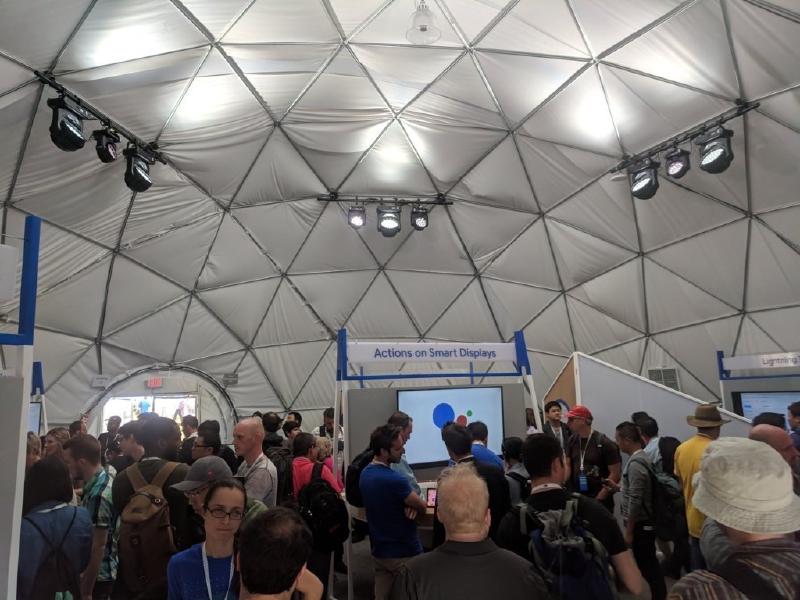
The Sandbox is a dedicated space for demos and demonstrations of Google products and works using those products, as well as demonstrations of how to use development tools announced in keynotes and sessions.
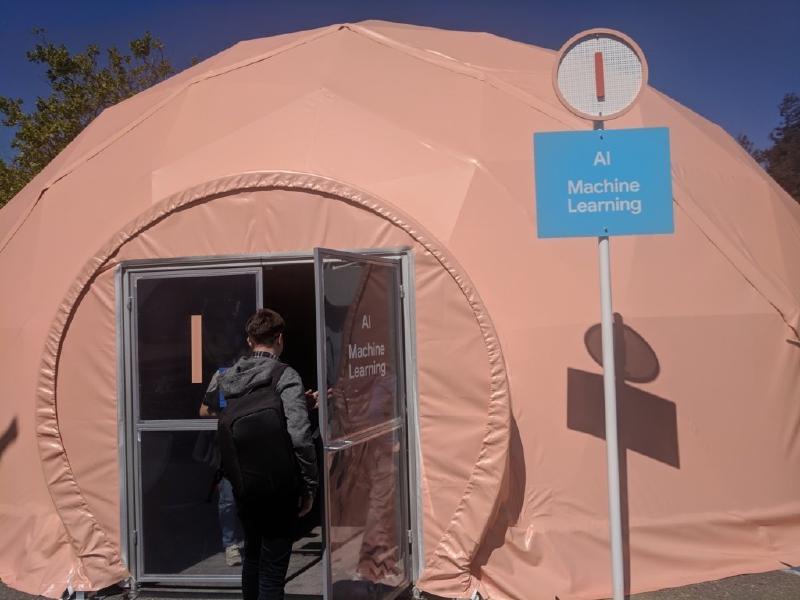
Dome-shaped spaces are set up for each section such as Android & Pay, AR/VR, Web & Payments, Cloud, Firebase & Flutter, Android Things & Nest, and anyone can enter and exit freely. There are Google staff inside explaining demos and tools, so you can easily talk to them.
Office Hours and App Reviews#
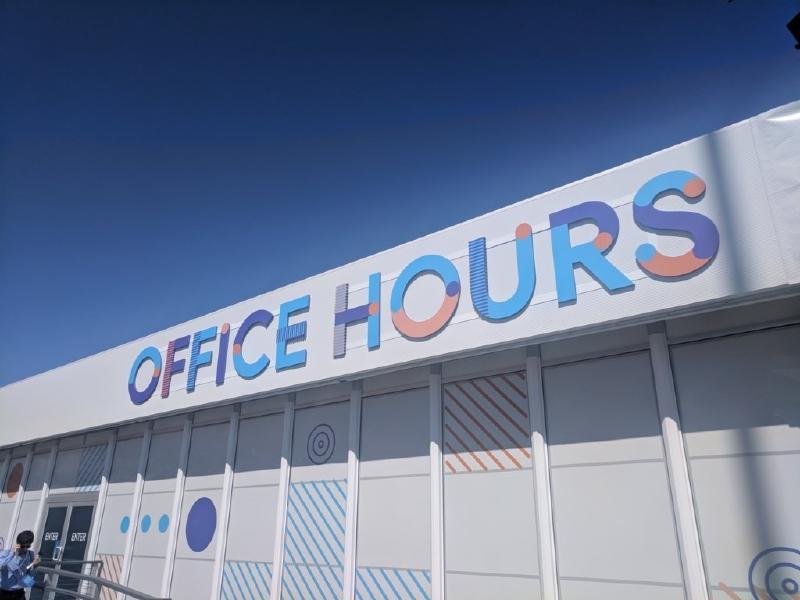
At Office Hours, you can ask questions individually to Google staff. In the Office Hours dedicated space, Google experts in each field are present at certain times, and by going there at the scheduled time, you can ask questions to Google experts in your field of interest.
In App Reviews, you can have your app reviewed and get specific advice and improvement points.
Personally Recommended Places for Interaction/Questions#
If you want an App Review, you need to book in advance and go to the designated place at the designated time, so booking seems important. (I wanted to do an app review locally on the last day, but it was fully booked and I couldn’t.)
For questions and interaction, I personally think the Sandbox is recommended. Of course, you can do it at Office Hours too, but Office Hours is truly a “space for asking questions”, so many participants are there asking questions to Google staff. In the case of the Sandbox, there are exhibits of demos and works, so I felt it was easier to talk because you can interact through those things. Of course, there are Google staff around the exhibits in the Sandbox too, so there was never a case where I wanted to ask a question but no Google staff were around.
What I Want to Do Next Time Upon Reflection#
Looking back on the period, I’ll reflect on what I should have done better. This isn’t really about questions or interaction, but just vague thoughts on what I’d like to do if I have the opportunity to go to I/O again, like winning the lottery again.
- Immerse myself in codelabs after the Keynote/Developer Keynote on the first day
Right after the Keynote/Developer Keynote on the first day, the codelab space is relatively empty. In the codelab space, you can do codelabs including contents announced at I/O using prepared PCs or your own PC/laptop. What I realized participating in codelabs this time is that the explanation content of codelabs overlaps significantly with the presentation content of sessions. When I listened to a session on the same topic after finishing one or two codelabs on the first day, the content came into my head much easier. Since I had touched the content once on code in the codelab, I could perceive the session as a kind of review. Of course, since I didn’t listen in real-time, I need to watch the session videos later at the hotel, but it seems easier to understand if I sandwich a codelab once rather than learning new content presentations suddenly in a session.
- Make friends with participants from other countries
Needless to say. This time, Stefan from Sweden, who was staying at the same hotel, spoke to me, and it was fun talking on the way to the venue together, so I’m becoming greedy wanting to increase such interactions next time.
- Apply sunscreen properly
Yeah, let’s apply it properly (๑•̀ㅂ•́)و✧ My neck and ears got sunburnt and stung.
- Bring eye drops
My eyes were itchy here and there, so it seems better to bring them.
Summary#
For this year’s Google I/O, I planned to get questions from as many people as possible before departure and do my best to ask them and get answers. The reason is clear: it lowers the psychological hurdle for the act of asking questions and interacting. Asking questions or interacting requires some courage, and I tend to avoid it making various excuses like “what if they make a face” or “what if it’s a weird question,” but since I received content people wanted me to ask, I could inspire myself saying “I have to ask as much as possible.” It goes without saying that it’s practice for English, and naturally, it becomes a trigger to know what I didn’t know. Even for content not announced in keynotes or sessions, by throwing it out there for now, I could be told the current status or policies like “we might do this in the future.” (Of course, sometimes they couldn’t tell me.) Thinking there seems to be a Win-Win-Win level merit, I felt like asking as many questions as possible.
There were others who accepted questions and brought back answers. The content of keynotes and sessions is piled up every year and catching up is hard, but besides official big announcements, I want to gather information on policies and gray zones steadily, sense the future flow even a little, and prepare for big updates.
Finally, I’ll close by thanking my company for letting me go to the venue as a general participant. Thank you very much. 🙏