This article has been translated by Gemini.
In this Notes article, I roughly jotted down notes in English from the content of the English session video/podcast. This article is intended to be read as a reference while watching the video. Please note that these are just rough notes or transcript-like content. I hope this article helps you even a little when you watch the actual video. (I would be happy if you could let me know if there are any errors or typos.)
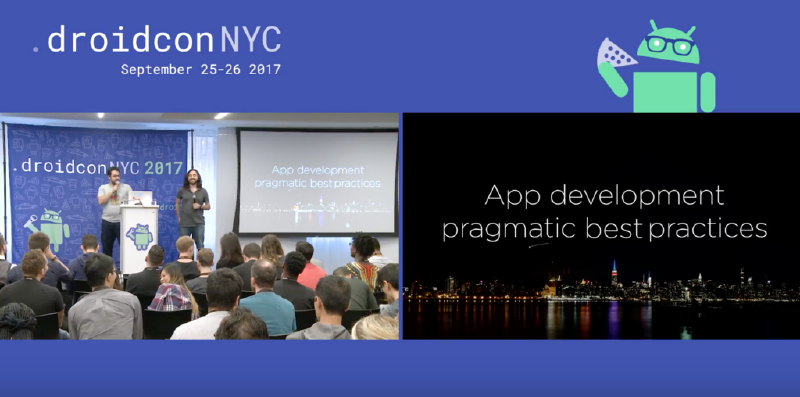
This article is based on droidcon NYC 2017 - App Development - Pragmatic Best Practices - YouTube.
The content of this session focuses on Android application architecture based on responses to a pre-session survey. Yigit and Israel explain their recommended architecture and development methods broadly (and with jokes here and there).
Since the talk is about very broad topic, they decided to take survey and they got 150 answers!
Survey#
Q: Most difficult part of building an app?
1st - Architecture
2nd - Android specifics
Q: What is a recurring problem in your codebase?
1st. Testing, Code bloat
2nd. Architecture
Q: What design patterns that you want to replace in your codebase?
60% of them:
- God classes
- God activities
- MVP
- MVC
- Mwhatever
- Lack of architecture
- Singletons
etc.
Talking about architecture, but why Now?#
Architecture was always there, but just popular now because..
Ecosystem gets mature now:
networking code => retrofit
image loading => glide, picasso
view fragments => fragments, conductor
APK needs to be small => split APKs etc
As Android platform becomes better, people’s expectations and apps become bigger as well:
60fps
lots of functionality, complex features
lots of integrations
works fully offline
(Gmail example) HTML everywhere, rich text editor
ART »» Dalvik
Yigit’s architecture recommendations#
Separation of Concerns#
Before building architecture, have separation of concerns first.
Have it in day one, stick to it
Make sure things deal with one thing
Build architecture over time, as needed
Be careful to write application in modularized way so that you can flex it to better suit your needs in the future.
Do Not Over-Engineer#
Libraries, guides are tools, not goals
The goal is to ship and maintain
Don’t use something just because X does
The problem is not yours , neither their solution
Israel’s architecture recommendation#
MVWW => Model View Whatever Works
Dependency Injection#
- Allows to declare dependencies of an object upfront
Single Responsibility#
Similar to “separation of concerns”
A class has only one reason to exist
Have layered architecture
View layer: View manipulation
Logic layer: Screen behavior
Data layer: Network, DB, Memory cache, Repository Interface
In Complex screens,
Multiple logic layer components each with a single responsibility.
Logic layer components can subscribe to events tied to their logic ( Rx, EventBus)
Shared Logic#
- E.g. Like a tweet
-> Have “Use Cases” to decouple logic and make it possible to reuse it within the app
“You don’t do this in day One; trying to solve a problem before it exists is a bad idea”
Goal#
Each layer has a reason to exist
Consistency in codebase
Testable logic layer
Reusable of logic layer
Android Specifics#
Lifecycles#
Embrace lifecycles, you cannot ignore
It is a solved problem, if you follow guides(but too many solutions you can apply out there)
If you have a proper separation lifecycle issue can be very tiny.
4 Options#
- Manual Lifecycle Handling
Not recommended
- Data Binding
Data Binding already knows how not to leak your Activity or observers, so you do not to need to think about lifecycle at all for normal cases
- Live Data
If you are comfortable using RxJava already then maybe no need
- AutoDispose
If you use RxJava you may want to use this
.autoDisposeWith(this).subscribe(adapter:setList)
Configuration changes#
- Config Change != App Restrat
Config Change#
Decouple UI and data
You may be able to use ViewModel
Views restore their states automatically
If UI is data drive, no extra work necessary
App Restart#
Derive UI from disk
Use savedInstanceState
- e.g. getIntent… setArguments .. etc.
Nothing in memory survives :(
NBU was one of the top problems in the survey
Saved State
View’s information(e.g. RecyclerView position)
UI’s arguments
Disk
- Application data
Fragmentation - how to deal with it#
Hardware#
Generate a class that defines hardware profile - low, medium, high depending on RAM and CPU cores and frequency
year-class lib foundation to classify hardware profiles https://github.com/facebook/device-year-class
Based on the hardware profile apply animations e.g. rich, medium or none animations
Dependencies#
RxJava
“With great power comes great responsibility”
You need to be careful what kind of operators you are using; you need to understand what you are using otherwise you break your application
Dagger 2
You need to build dependency graph
many annotations to remember
Warnings#
Rx and Dagger help to scale your app
It comes at a cost. Learning their DSL, idioms.
The team needs to learn it and grow criteria for code reviews.
Moreover, many new hires will need to learn Android and these new idioms all at once.
Testing#
If you want to refactor you need to have test.
Testing is a must!
If there are tests, make sure they pass
If there are no tests, at first, write them
Unit test logic layer (at least)
Best answers#
Q: What is a recurring problem in your codebase?
- Keyboard
Q: Patterns you dislike and will like to replace in your code base?
- Hungarian notation
Q: What is the best part of your codebase?
- None
That’s all!